Introduction
AI is often described as a useful tool that answers questions. That description is not wrong. For one-off tasks like research or brainstorming, that framing works perfectly well.
But as I kept using AI for work, personal projects, and setting up my solo business, I started to feel that this framing was not quite enough in some situations. When I had to work across many moving parts and keep making progress in unfamiliar areas, AI worked better not just as a tool I used on demand, but as something with a role that could stay alongside me over time.
In this article, I will explain why I started thinking about AI this way.
What This Article Covers
- Why using AI only as a "useful tool" started to feel insufficient to me
- What I mean in this article by an AI that "works alongside you with a role"
- How I actually use that idea in practice
1. Why the "useful tool" framing stopped being enough
One-off use keeps breaking context
For one-off questions, AI is an excellent tool. That was how I used it at first as well. I asked questions, got draft text, and used it for quick back-and-forth thinking. Within that scope, there was no real problem.
But once the number of things I was dealing with increased, that model started to feel limiting. Some work is not about answering a single question and moving on. It is about moving across multiple issues while keeping track of what has already been discussed and what still needs to be decided.
Some work cannot be organized through answers alone
When you start something new, one kind of expertise is rarely enough. You have to think about what to prioritize, where the risks are, what must be decided now, and what can wait. Those are not always problems that can be handled well by asking for a single correct answer.
What felt insufficient to me was not the capability of AI itself, but the assumptions behind how I was using it. If I treated AI only as a one-off consultation tool, context kept resetting and roles stayed vague. In longer-running work, what mattered more was not just getting an answer, but having help from a clear point of view and being able to continue the same conversation.
2. My perspective changed when one person could no longer hold everything alone
This became much clearer when I started my solo business. Suddenly I had to think about many different things at the same time: accounting, tax questions, business planning, communication, and product direction.
Of course, I could ask AI about each topic one by one. That is exactly what I did at first. But after doing that for a while, I began to feel that what I needed was not simply a convenient tool I could ask from scratch each time. I needed something I could keep consulting from the same starting point.
For example, when I needed help with accounting or tax-related questions, I did not just need general information every time. What mattered more was being able to continue from the same assumptions: where I tended to hesitate, what kind of decisions slowed me down, and what kind of context had already been built. The same was true for business direction. It was easier to think with something that could keep running context than with isolated bursts of ideation.
That was when my view of AI began to change. Instead of asking one supposedly all-purpose AI to do everything, it started to make more sense to think in terms of separate roles with different responsibilities and perspectives. That became the starting point of this idea.
3. What I mean by "teammate" in this article
This is not about emotions
By "teammate," I am not talking about emotions.
What I mean is using AI not as something you start from zero each time, but as something you can keep consulting while sharing the same starting assumptions. That is the sense in which I use the word "teammate."
What changes is your expectation
That difference is not just a change in wording. If you see AI as a tool, it becomes something you use and reset. If you see it as a teammate, you start thinking about design questions: what role it has, what it should remember, and what kind of work it should help with. In other words, your expectations change.
The distinction can be summarized roughly like this:
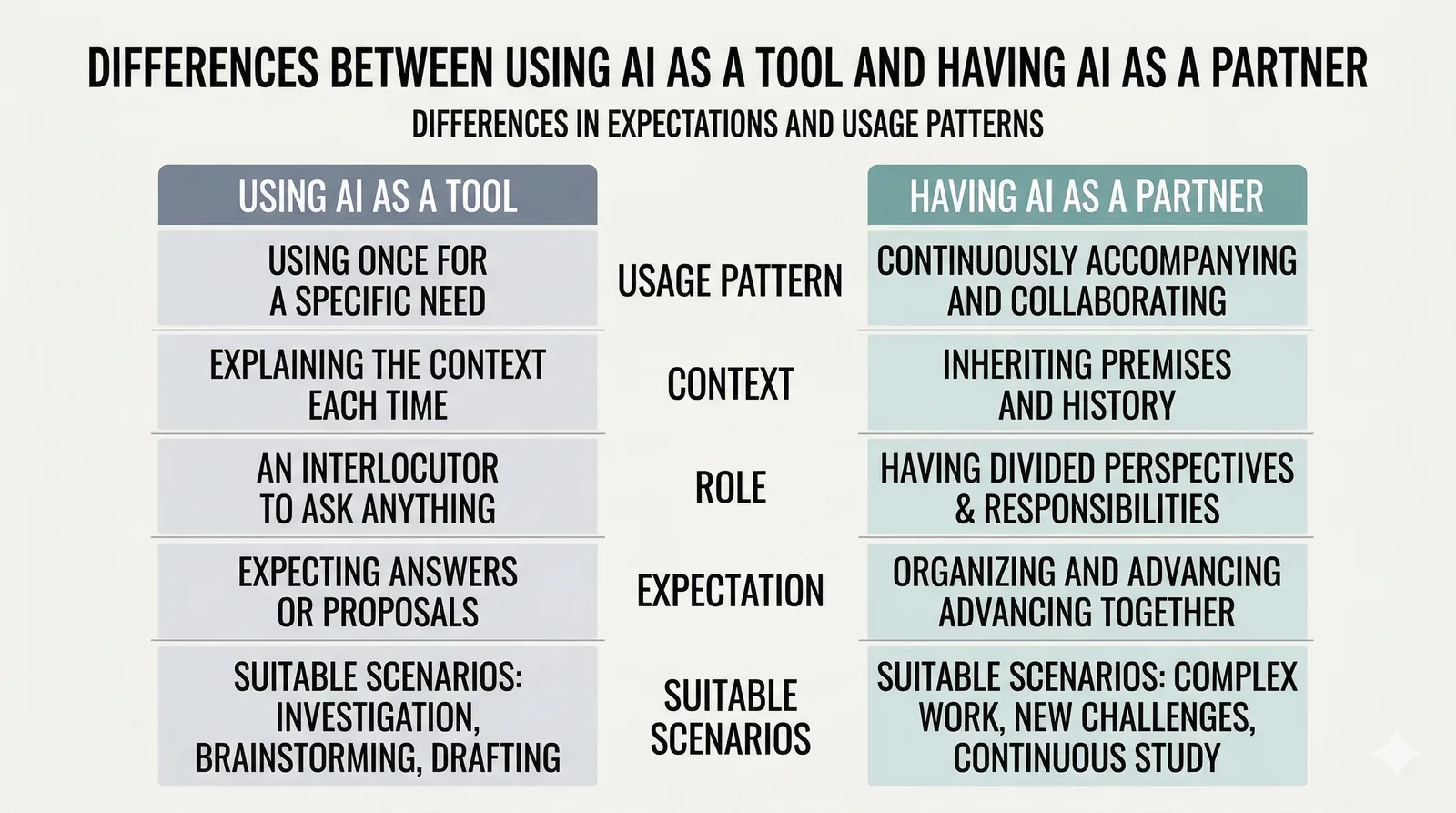
Of course, AI does not replace people. But you can use AI as something that brings additional perspective into work that one person would otherwise have to carry alone. That is what I mean here by a teammate.
4. "AI team" is the practical shape this idea took for me
I split AI by role
Once my way of seeing AI changed, the way I used it changed as well. Instead of asking one AI to do everything, I started separating roles. I now call this way of working an "AI team."
If I turn that role split into a simple diagram, it looks something like this:
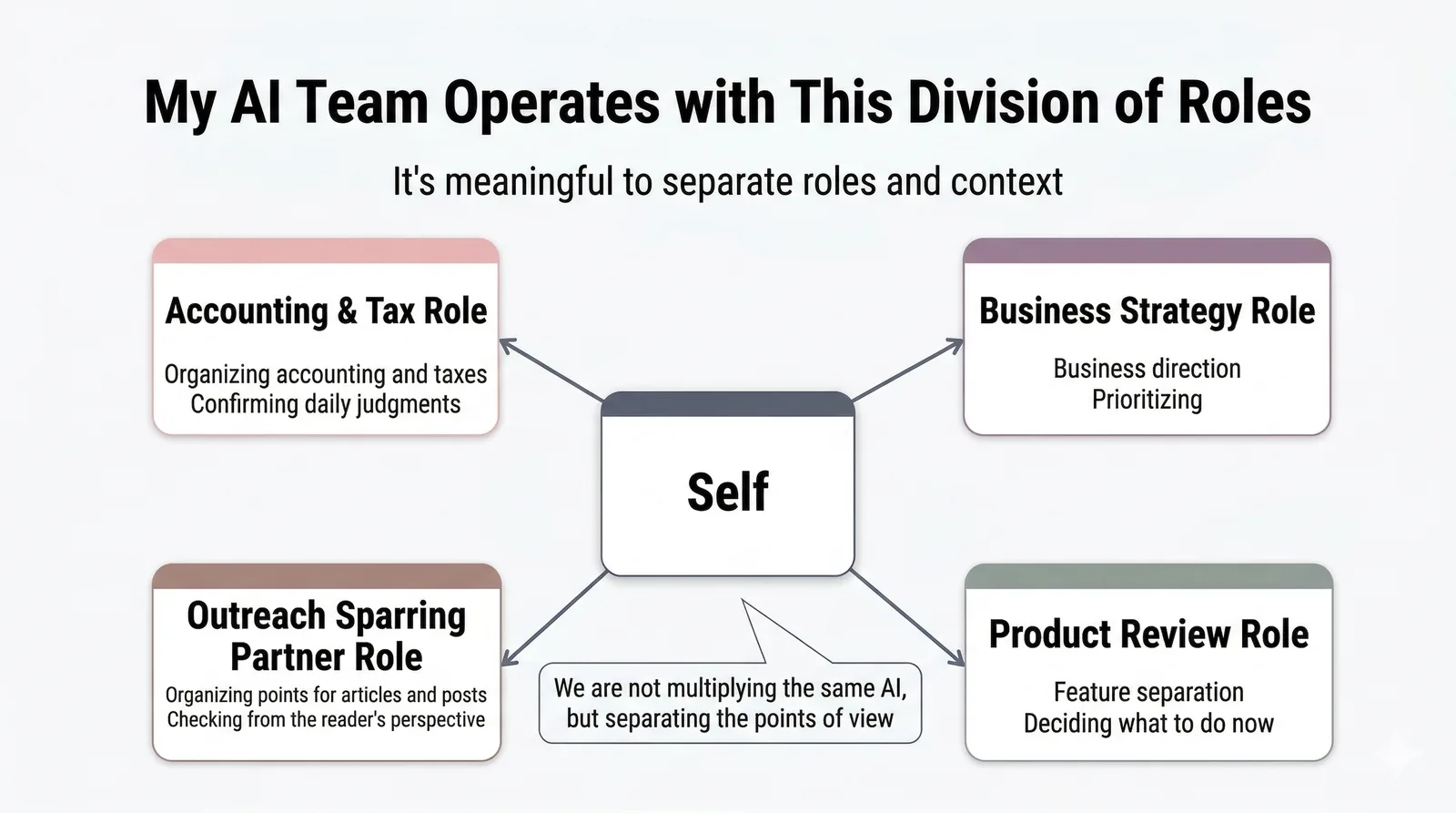
For example, when I want help organizing accounting or tax-related questions, I use an AI role focused on that area. When I want to think about business direction or priorities, I use a different role that works alongside me from a different perspective. Because each role is given a different focus, even the same topic produces different kinds of help.
This is role separation, not just multiple chats
The important part is not just that there are multiple chats. What matters is separating who I ask about what. That makes it much easier to continue work over time without restating everything from zero.
What matters is not presentation, but role and context. For me, the idea of an AI team became a practical way to make this "AI as teammate" idea usable in day-to-day work.
5. How did work actually change when I started keeping AI as a teammate?
It became easier to organize scattered issues
What changed was not just how I felt. The biggest shift was that it became easier to move forward while organizing the kinds of issues that would otherwise scatter in one person's head.
When you start something new, decisions keep coming: what to tackle first, where the risks are, and what does not need attention yet. Having multiple AI roles with different perspectives made it easier not to carry all of that inside a single mental thread.
It reduced the effort of thinking from scratch every time
It also reduced the effort of restarting thought from zero. If you repeat one-off consultations, you have to re-explain assumptions every time and reconstruct how the current question connects to what you were thinking before. With role-based AI that keeps context over time, that burden gets lighter.
More than getting answers, what mattered most to me was having help organizing what I should be thinking about right now.
Even so, having a base of multiple perspectives made a real difference to the uncertainty and trial-and-error that come with doing something for the first time. For me, that was the biggest change.
6. What does it mean to expect AI to be a teammate?
What I do not mean
When I say I keep AI as a teammate, I do not mean expecting it to replace people or act as some perfect autonomous system.
What kinds of situations it fits
What I mean is almost the opposite: a way of bringing multiple perspectives into work that would otherwise be too much for one person to carry alone. It is a way of making sure you are not thinking in isolation all the time.
This way of working will not fit every person or every task. But for people who have to think across many areas alone, or who are stepping into new territory, I think it can be very effective.
AI can absolutely be used as a tool, and in many situations that is enough. But I now think there is another meaningful way to hold it: not only as something you use when needed, but as something that keeps working alongside you through a role. That shift in perspective may matter more than it first seems.
Conclusion
In this article, I explained why I stopped seeing AI only as a convenient tool and started seeing it as something that can work alongside me through a role. The practical form that took for me was an "AI team" made up of different roles.
The question is not only how to use AI, but what kind of presence you want AI to be in your work. I think that question may turn out to be more important than it first appears.